


You know that drained, overwhelmed feeling? It’s sending you a message. But treating burnout like everyday stress is like trying to refill an empty battery with more pressure. It just won’t work, and you’ll feel worse.
Knowing the real difference between burnout and stress is your first step out of the fog. This isn’t just wordplay; it’s the key to getting the right help. We’ll break down the key signs, explain the science in simple terms, and show you exactly how to tell burnout vs stress apart. Let’s get the clarity you need.
Too Long; Didn’t Read (TL;DR)
- Stress is too much, burnout is too little. Stress feels like drowning in demands; burnout feels emotionally empty and detached.
- Stress symptoms are loud: anxiety, irritability, overwhelm, and physical tension. Your engine is overheating but still running.
- Burnout symptoms are quiet but deep: exhaustion, cynicism, lack of accomplishment, and withdrawal. Your engine has shut down.
- The core difference between burnout and stress: stress makes you over-engaged, burnout makes you disengaged. One is about pressure, the other is about depletion.
- Recovery is different: manage stress by setting boundaries and calming your nerves; heal from burnout with real rest, reconnection, and often professional support.
Stress vs Burnout: What is the Difference?
In the simplest terms, stress vs burnout comes down to engagement versus detachment.
When you’re stressed, you are over-engaged. Your emotions are overactive, you’re drowning in responsibilities, and you feel a frantic pressure to keep going. Your energy is depleted, but your motivation to solve the problem is often still high.
Burnout is the opposite. It’s characterized by disengagement. It’s a state of emotional, physical, and mental exhaustion caused by prolonged or repeated stress. Where stress makes you feel like you’re drowning, burnout makes you feel all dried up. You lose interest, motivation, and the ability to care about the things that used to matter to you.
The World Health Organization (WHO) classifies burnout specifically as an “occupational phenomenon” (not a medical condition) resulting from chronic workplace stress that hasn’t been successfully managed.
Remember that these conditions, like all other mental health issues, are manageable. With current changes in mental health protocols, seeking professional help using health insurance in the UAE can be a good option for everyone.
What is Burnout?
Scientifically, burnout is defined as a syndrome resulting from chronic workplace stress that has not been successfully managed. It’s characterized by three dimensions:
- Feelings of energy depletion or exhaustion.
- Increased mental distance from one’s job, or feelings of negativity or cynicism related to one’s job.
- Reduced professional effectiveness.
In plain language, burnout is the complete emotional and physical battery drain you get from long-term, unresolved stress. It’s not just a bad week; it’s a fundamental shift in how you relate to your work and life.
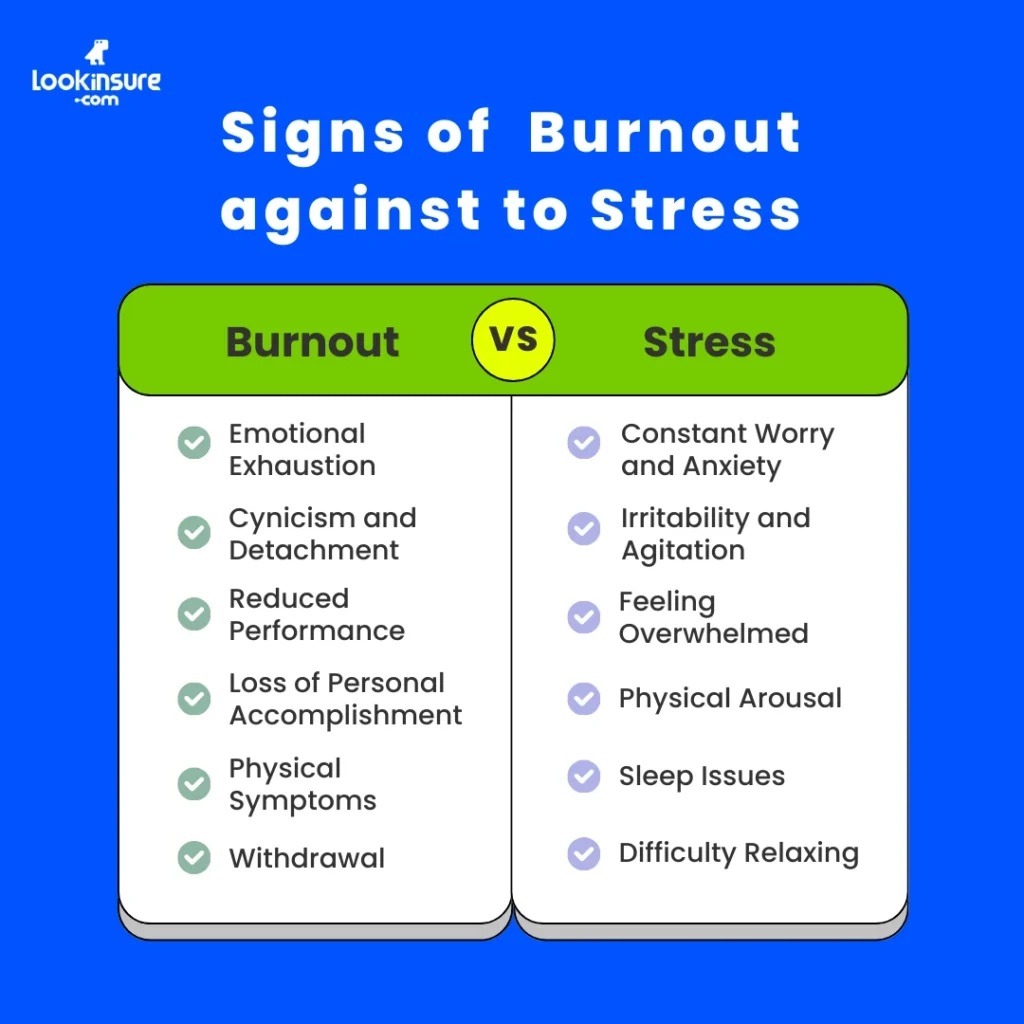
Signs of Burnout
The signs of burnout are often more subtle and pervasive than stress. They creep in and color everything:
- Emotional Exhaustion: You feel drained, depleted, and fatigued most of the time. The thought of your responsibilities makes you feel tired.
- Cynicism and Detachment: You develop a negative, callous, or excessively detached attitude toward your job, colleagues, or responsibilities. You might refer to work as “just a paycheck.”
- Reduced Performance: You find it hard to concentrate, are increasingly forgetful, and struggle to be productive. Tasks take longer and feel insurmountable.
- Loss of Personal Accomplishment: You feel incompetent and that nothing you do matters or makes a difference. You doubt your own abilities.
- Physical Symptoms: Chronic headaches, stomach aches, changes in sleep or appetite that don’t have another clear cause.
- Withdrawal: You pull away from social activities, hobbies, and even family because you simply have nothing left to give.
What is Stress?
Scientifically, stress is the body’s natural reaction to any demand or threat. A “fight-or-flight” response. It’s a state of mental or emotional strain resulting from demanding circumstances. It’s your body’s way of rising to a challenge.
In simple terms, stress is what you feel when the demands placed on you (deadlines, conflicts, to-do lists) exceed your perceived ability to cope. It’s an over-engagement with pressures.
Signs of Stress
The signs of stress are usually more acute and activating:
- Constant Worry and Anxiety: Your mind races with “what ifs” and worst-case scenarios.
- Irritability and Agitation: You have a short fuse, feel tense, and snap at people easily.
- Feeling Overwhelmed: You feel like you’re drowning in tasks and can’t catch up.
- Physical Arousal: Muscle tension, clenched jaw, headaches, rapid heartbeat, or stomach problems.
- Sleep Issues: Difficulty falling asleep because your mind won’t shut off, or restless sleep.
- Difficulty Relaxing: You find it hard to truly switch off, even during downtime.
Difference Between Burnout and Stress
This table should make the difference between these two conditions crystal clear:
| Aspect | Stress | Burnout |
| Primary Feeling | Over-engagement, overwhelm, anxiety. | Disengagement, emptiness, detachment. |
| Energy State | Hyperactive, drained but wired. | Depleted, drained and empty. |
| Emotions | Urgent, anxious, irritable, angry. | Hopeless, numb, cynical, defeated. |
| Damage Type | Primarily physical (if chronic). | Physical, emotional, and mental. |
| Cause | Too many pressures and demands. | The long-term result of unmanaged stress; feeling undervalued, lacking control. |
| Focus | “I have too much to do.” | “I don’t care anymore.” |
| Outcome | Can lead to anxiety disorders, high blood pressure. | Leads to detachment, depression, complete loss of motivation. |
| Recovery View | Seeing the light at the end of the tunnel. | Seeing a long, dark tunnel with no light. |
Looking at your own burnout and stress symptoms through this lens can be incredibly revealing.
How to Deal With Stress vs Burnout?
The strategies differ because the problems are different.
For Stress: The goal is to reduce the pressure and calm the nervous system.
- Set Boundaries: Learn to say “no” and delegate tasks.
- Practice Time Management: Prioritize and break large tasks into small steps.
- Incorporate Relaxation: Deep breathing, short walks, mindfulness, or exercise to discharge nervous energy.
- Problem-Solve: Address the specific sources of pressure directly where you can.
For Burnout: The goal is to recharge and reconnect.
- Prioritize Rest: This is non-negotiable. You need genuine downtime without guilt.
- Re-evaluate Goals: Ask yourself what’s truly important. It may be time to reset expectations.
- Seek Connection and professional help: Counteract detachment by slowly re-engaging with supportive people, even in small ways.
- Find Small Wins: Do something you’re good at, unrelated to work, to rebuild a sense of accomplishment.
An important part of dealing with both is having a safety net. This is where our services in Lookinsure can be useful. We help you find health insurance plans that understand modern wellness needs. The right plan can provide access to professional therapists, counselors, and mental health support, making it easier and more affordable to get the help you need before a situation escalates.
When to Seek Professional Help?
You should consider seeking help from a doctor or therapist if:
- Your symptoms (burnout and stress symptoms) are severely impacting your daily life, work, or relationships.
- You have feelings of deep hopelessness or worthlessness.
- You’re using alcohol, drugs, or other substances to cope.
- You have thoughts of harming yourself or others.
- Self-help strategies haven’t made a difference after several weeks.
There is no shame in seeking help. It is a sign of strength and the most direct path to recovery.
Conclusion
Knowing about the battle of burnout vs stress gives you the power to fight the right fight. Stress shouts at you that you’re drowning in demands, while burnout whispers that you have nothing left to give. By learning their differences and recognizing your own burnout and stress symptoms, you move from feeling helpless to being in control.
Remember, your well-being is the foundation for everything else. Protecting it, sometimes with the help of professionals and the right health insurance for psychological disorders, isn’t a luxury; it’s essential.
Frequently Answered Questions
1. Is burnout considered a medical condition?
No, burnout is not classified as a medical disease. The World Health Organization defines it as an “occupational phenomenon” in its International Classification of Diseases (ICD-11). However, its severe symptoms often require medical or psychological treatment.
2. How to recover from burnout?
Recovery requires time and a focus on replenishment. Key steps include: 1) Taking real time off to rest, 2) Setting firm boundaries at work, 3) Seeking support from a therapist or counselor, 4) Reconnecting with hobbies and people you enjoy, and 5) Re-evaluating your work and life priorities.
3. What are the 5 stages of burnout?
While not officially medical stages, a common model describes: 1) The Honeymoon Phase (high energy and optimism), 2) Onset of Stress (awareness that some days are difficult), 3) Chronic Stress (constant feeling of pressure), 4) Burnout (full-blown symptoms as described above), and 5) Habitual Burnout (symptoms become embedded in your life).
4. Can stress turn into burnout?
Yes, absolutely. Burnout is often the end result of prolonged, unmanaged chronic stress. When stress is constant and you don’t have the resources or coping mechanisms to recover, it can deplete your emotional and physical reserves, leading to burnout.
5. What are the signs of burnout?
Key signs of burnout include constant exhaustion, cynicism and detachment from your job, feeling like your work doesn’t matter, reduced performance and concentration, and physical issues like headaches or sleep problems without another cause.
6. How to deal with stress quickly?
For quick stress relief, try the “5-4-3-2-1” grounding technique: Name 5 things you see, 4 things you feel, 3 things you hear, 2 things you smell, and 1 thing you taste. Also, taking 5 minutes for deep, slow breathing or a brisk walk can help calm your nervous system immediately.




Comments (0)
Leave a comment