When we think about our health, it’s easy to focus on the physical, a broken bone, a high fever, a bad cough. But our mental well-being deserves the same level of care and attention. The challenge is, seeking help for something like depression can feel confusing, and the expenses for therapy sessions, psychiatric care, and prescription medications can really add up. It’s no wonder one of the most common and pressing questions people have is: does health insurance cover depression?
The good news is, yes, it can. But there’s a big “if” attached. Health insurance in the UAE will cover treatment for depression if your specific policy includes mental health benefits.
In the sections below, we’ll walk you through exactly what that means: what kind of treatments are typically covered, what common exclusions to look out for, and how you can find a plan that provides the right kind of support.
What is Depression?
To understand how depression insurance in the UAE works, it helps to know how the medical world defines it. Depression, clinically known as Major Depressive Disorder (MDD), is not simply feeling down. It’s a serious mood disorder with specific diagnostic criteria.
According to the Diagnostic and Statistical Manual of Mental Disorders, Fifth Edition (DSM-5), a Major Depressive Episode involves experiencing five or more of the following symptoms during the same two-week period, representing a change from previous functioning. At least one of the symptoms must be either (1) depressed mood or (2) loss of interest or pleasure:
- Depressed mood most of the day, nearly every day.
- Markedly diminished interest or pleasure in all, or almost all, activities.
- Significant weight loss/gain (more than 5% of body weight in a month) or change in appetite.
- Insomnia (can’t sleep) or hypersomnia (sleeping too much) nearly every day.
- Fatigue or loss of energy nearly every day.
- Feelings of worthlessness or excessive/inappropriate guilt.
- Diminished ability to think, concentrate, or make decisions.
- Recurrent thoughts of death, suicidal ideation, or a suicide attempt.
These symptoms must cause significant distress or impairment in daily life and not be due to substance use or another medical condition. For depression coverage in health insurance to apply, a licensed professional like a psychiatrist must provide this formal clinical diagnosis.
An Important Note on Diagnosis: It’s also important for a proper diagnosis to rule out other conditions. For instance, a depressive episode can sometimes include psychotic features (like delusions or hallucinations). More importantly, what looks like a major depressive episode could actually be part of bipolar disorder, if the person has also had past episodes of mania or hypomania (periods of abnormally elevated mood and energy). This distinction is critical, as it affects long-term treatment plans.

Does Health Insurance Cover Depression in the UAE?
The short answer is increasingly yes, but with important cautions. The UAE insurance market has seen a positive shift, with more mid-tier and comprehensive plans now including mental health benefits. However, basic or mandatory plans (like Dubai’s Essential Benefits Plan) often provide very limited or no coverage.
A key feature of depression insurance in the UAE is the common use of coinsurance or co-payments. This means that for each covered session or treatment, you might pay a fixed percentage (e.g., 20% or 30%), while the insurer covers the rest, up to your plan’s annual limit. There will also be a defined network of approved psychiatrists, psychologists, and clinics, and you will likely need a referral or pre-authorization for treatment to be covered.
What is Covered in Insurance for Depression?
If your plan includes mental health benefits, here are the types of treatments and services that are commonly covered. The specifics, like session limits and co-pay amounts, will be in your policy’s Schedule of Benefits.
| Type of Service / Treatment | What It Typically Includes |
| Outpatient Psychiatric Consultations | Visits to a psychiatrist for diagnosis, medication management, and follow-ups. |
| Psychotherapy / Counselling Sessions | Talk therapy (e.g., Cognitive Behavioral Therapy) with a licensed psychologist or therapist. |
| Inpatient Treatment | Hospitalization for severe depressive episodes requiring 24/7 medical supervision. |
| Prescription Medications | Antidepressants (like SSRIs or SNRIs) prescribed by a network psychiatrist. |
| Diagnostic Assessments | Psychological evaluations and testing required to establish the diagnosis. |
What is Not Covered in Insurance for Depression?
Knowing about exclusions is just as important as knowing what’s covered. Here are common items typically not covered, even under plans with mental health benefits.
| Common Exclusion | Reason / Explanation |
| Treatment Without a Clinical Diagnosis | General wellness coaching, life counselling, or marital therapy not tied to a diagnosed MDD episode. |
| Out-of-Network Providers | Seeing a therapist not on your insurer’s approved list, unless it’s a pre-authorized emergency. |
| Experimental or Alternative Therapies | Treatments not widely accepted as standard medical practice for depression. |
| Conditions Primarily from Substance Abuse | Treatment for depression deemed a direct result of unaddressed drug/alcohol dependency. |
| Educational Programs & Retreats | Workshops or courses, even if therapeutic, that are not provided by a licensed clinician. |
Waiting Period for Depression Coverage
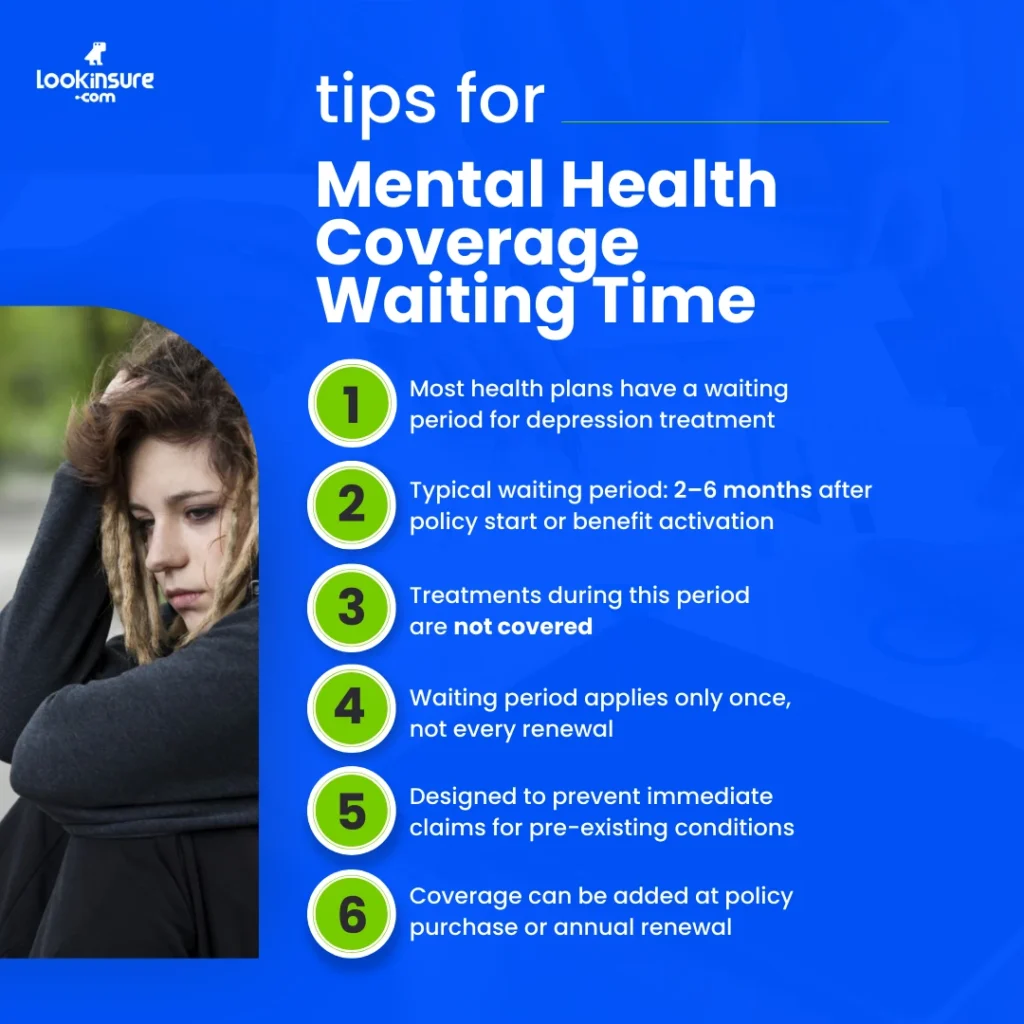
Most plans that include mental health benefits apply a waiting period. This is a set time after your policy starts (or after you add the benefit) during which you cannot claim for depression treatment.
- A typical waiting period ranges from 2 to 6 months.
- This means if you seek treatment for a diagnosed depressive episode within this initial period, the costs will likely not be covered.
- The waiting period usually applies only once when you first get the coverage, not at every annual renewal.
This is a standard practice to prevent people from taking out a policy solely for immediate pre-existing treatment. You can usually add depression coverage in health insurance when you first buy a policy or at your annual renewal.
How to Buy Depression Insurance in the UAE?
Here’s a practical step-by-step approach for finding the right coverage:
- Check Your Current Plan: Dig out your policy document and look for sections titled “Mental Health,” “Psychiatric Benefits,” or “Behavioral Health.” Note the annual limit, per-session caps, and co-payment percentage.
- Define What You Need: See if you need outpatient therapy, psychiatric care, medication, or both. Do you have a specific clinic or professional in mind?
- Compare Plans Directly: When looking at new plans, don’t just compare premiums. Search for mental health benefits: What’s the annual maximum? How many sessions are allowed? What is the co-pay?
- Ask the Right Questions: Contact insurers or brokers and ask directly: “What is the coverage for Major Depressive Disorder? Is there a network list for psychiatrists? What is the waiting period?”
- Use a Brokerage Service for Clarity: You don’t have to become an insurance expert to find the right coverage. Platforms like Lookinsure are built to translate complex policy details into clear, comparable information, putting you back in control of the decision. We simplify the comparison process, you can use it to see plans that include depression insurance in the UAE from multiple providers side-by-side.
- Prepare Your Documents: Before you even think about applying, get your shit together. You’ll need these ready to go:
- Your valid Emirates ID (front and back copies).
- A clear copy of your passport and visa page.
- Proof of address (like a recent utility bill or tenancy contract).
- Any previous medical reports or prescriptions if you’re declaring a history. They might ask.
- Review and Activate Your New Policy: After approval, carefully review your final policy document. Ensure all the discussed mental health benefits are correctly listed. Once confirmed, proceed with activation. Save your digital insurance card and the insurer’s customer service/claims contact details in an easily accessible place, so you’re ready to seek care when you need it.
In the end, taking care of your mental health is not a luxury, it’s a necessity. Depression is a real condition that deserves understanding, support, and proper treatment, just like any physical illness. Knowing what your health insurance covers can make the journey feel less overwhelming and help you focus on what truly matters: healing, balance, and feeling like yourself again.
Frequently Answered Questions
1. Can I choose my own therapist if I have mental health coverage?
You can choose any licensed therapist, but for the insurance to pay, they usually must be within your insurer’s approved network. You can ask your insurer for their provider directory. Going outside the network typically means paying the full cost yourself.
2. Does depression insurance also cover medications?
Yes, if your plan includes outpatient mental health benefits, it generally covers prescription medications for depression that are prescribed by a network psychiatrist and are on the insurer’s approved medication list. You will likely have a pharmacy co-payment.
3. Is there a limit to how many therapy sessions I can have?
Almost always. Plans typically set an annual limit, such as 20 or 30 sessions per year, and a maximum amount they will pay per session (e.g., AED 350). Costs beyond these limits would be out-of-pocket.
4. Does depression have a waiting period?
Yes, it commonly does. A standard waiting period of 2 to 6 months from the policy start or upgrade date is applied for mental health conditions.
5. Is meditation covered by insurance?
No, meditation is generally not covered. While beneficial for wellness, it is not considered a medically necessary treatment provided by a licensed professional for a diagnosed condition like Major Depressive Disorder.
6. What are the other diseases covered by mental health insurance plans?
Comprehensive plans often also cover conditions like Generalized Anxiety Disorder (GAD), Panic Disorder, Obsessive-Compulsive Disorder (OCD), Post-Traumatic Stress Disorder (PTSD), and Bipolar Disorder, provided they are clinically diagnosed.