





Car insurance in Dubai works as a yearly contract: you pay a licensed insurer a premium, and the insurer pays for the losses your policy covers, minus an excess you agree to carry yourself. Every vehicle registered in the UAE must hold at least third-party liability cover, and in Dubai the Roads and Transport Authority (RTA) will not register or renew a car without a valid policy. This guide explains how car insurance works in Dubai from the day you buy a policy to the day a claim is paid, so you know exactly what you are paying for before you run a car insurance Dubai comparison.
Table of Contents
Key takeaways
- Legal minimum: third-party liability (TPL) cover, set by the Unified Motor Vehicle Insurance Policy and supervised by the Central Bank of the UAE.
- Two cover types: TPL pays for injury and damage you cause to others; comprehensive also pays for your own car, including theft and fire.
- Price: TPL starts from AED 600 a year and comprehensive from AED 1,350 a year on Lookinsure (verified October 2026).
- Excess: on every own-damage claim you pay the first part of the bill; the insurer pays the rest.
- After an accident: the police report decides who is at fault, and the at-fault driver’s insurer pays the other driver.
- Next year: a claim-free year earns a no-claims discount; an at-fault claim usually removes it.
What is car insurance?
Car insurance, also called motor insurance or auto insurance, is a contract in which a vehicle owner pays a premium to a licensed insurer, and the insurer agrees to pay for specified losses involving that vehicle. In the UAE those losses are injury or damage caused to other people and, on a comprehensive policy, damage to or theft of the insured car itself.
The car insurance meaning in the UAE is narrower than in many countries because the minimum terms are written into regulation, not left to each company. The policy follows the vehicle rather than the driver, and the RTA checks it electronically at every registration and renewal. That third-party protection is the reason why car insurance is mandatory for every car on UAE roads, whether it is driven daily or parked most of the year.
How car insurance works, step by step
Car insurance works by pooling risk. Thousands of drivers each pay a premium priced to their own chance of claiming, and the insurer pays the claims of the few who have an accident out of that shared pool. Each policy follows the same cycle:
- Underwriting. You give the insurer your age, licence history, claims record, emirate of registration and the car’s make, model, year and value. The insurer prices the risk from these details.
- Premium. You pay the premium once, in full, or in instalments through a buy-now-pay-later provider.
- Cover period. The policy runs for a year. Lookinsure policies are issued for 13 months as standard, 12 months plus a one-month grace period, so the annual RTA registration renewal does not fall into a gap.
- Claim. If an accident, theft or covered event happens, you report it to the police and to your insurer.
- Settlement. The insurer repairs your car or pays out, minus your excess, or pays the other party if you were at fault.
- Renewal. Your claims history from the year just ended feeds next year’s price.
The rules every UAE car insurance policy follows
Every motor policy in the UAE is built on the Unified Motor Vehicle Insurance Policy, issued under Insurance Authority Board Decision No. 25 of 2016 and now administered by the Central Bank of the UAE. It fixes the minimum third-party limits, so no insurer can sell a policy below this floor. These are the car insurance limits explained in plain terms:
| What the policy covers | Limit set by the Unified Policy |
|---|---|
| Death or bodily injury of other people | No upper limit: the insurer pays the amount a court awards |
| Damage to other people’s property, including their car | Up to AED 2,000,000 per accident |
| Death of the insured’s or driver’s spouse, parent or child | Up to AED 200,000 per person |
| Repairs to a car first registered less than a year ago | Agency repair with new parts and no depreciation |
| Depreciation on replaced parts of a private car | 5% in year two, 10% in year three, 15% in year four, 20% in year five, 30% from year six |
| Excess on an injured third party’s compensation | Not allowed: the insurer may not deduct an excess from a third party’s payout |
| Notifying police and the insurer | Within a reasonable time after the accident; no fixed number of days |
| Maximum standard excess on your own car (private car, at-fault claim) | AED 350 for a car worth up to AED 50,000; AED 700 up to AED 100,000; AED 1,000 up to AED 250,000; AED 1,200 above that; AED 1,400 above AED 500,000 |
| Extra excess for a driver under 25 | Up to 10% of the claim on top of the standard excess; not applied to a total loss |
| Payment of a total-loss claim | Within 15 days of the claim documents being complete |
Sources: Central Bank of the UAE rulebook, the Unified Motor Vehicle Insurance Policy against third-party liability and against loss and damage, and Article 7 of Insurance Authority Board Decision No. 25 of 2016, all checked on 14 October 2026.
Driving an uninsured vehicle in the UAE carries a standard AED 500 fine, 4 black points on your driving licence and confiscation of the vehicle for up to 7 days. The wider legal framework, including how policies are filed with the traffic authority, is covered in our guide to UAE car insurance law.
Types of car insurance in the UAE
There are two types of car insurance in the UAE: third-party liability, the legal minimum, and comprehensive, which adds cover for your own car. Third-party car insurance pays for what you do to others and nothing for your own vehicle. Comprehensive car insurance pays for both. Everything else, from agency repair to Oman cover, is an add-on bolted onto one of these two.
| Car insurance coverage | Third-party liability (TPL) | Comprehensive |
|---|---|---|
| Injury to other people | Yes, unlimited | Yes, unlimited |
| Damage to other people’s cars and property | Yes, up to AED 2,000,000 | Yes, up to AED 2,000,000 |
| Accident damage to your own car | No | Yes, minus your excess |
| Theft and fire | No | Yes |
| Flood, storm and natural perils | No | Usually, check the policy wording |
| Agency repair | No | Standard on new cars, optional add-on later |
| Starting price on Lookinsure (October 2026) | From AED 600 a year | From AED 1,350 a year |
Choose comprehensive if your car is financed, under five years old or worth more than roughly AED 30,000, because a single at-fault accident would cost more than the price difference. Choose TPL only for an older, lower-value car you could afford to repair or replace yourself. Our full comprehensive vs third-party comparison works through the edge cases.
Conventional and takaful car insurance
Takaful car insurance follows the same legal limits and claims process as conventional cover, but the structure is different. Policyholders contribute to a shared fund managed by a takaful operator under Sharia principles, and a surplus left after claims and costs may be returned to participants. For the driver, the cover, the police-report process and the excess work the same way. Salama car insurance and Watania car insurance, formerly sold as Noor Takaful, are two takaful options you can price side by side with conventional insurers.
Car insurance terms that decide what you get paid
| Term | What it means in practice |
|---|---|
| Premium | The price of the policy for the year. It is paid upfront or in instalments and is not refunded if you make no claim. |
| Excess (deductible) | The first part of an own-damage claim you pay yourself. In the UAE, excess and deductible mean the same thing. The regulation caps it by car value: on a AED 6,000 repair to a car worth AED 120,000, the standard excess is at most AED 1,000, so the insurer pays at least AED 5,000. |
| Insured value | The agreed market value of your car. It caps what you receive for a total loss or theft, and it falls each year as the car ages. |
| Depreciation | A percentage the insurer deducts from the cost of replaced parts on older cars, unless you buy a zero-depreciation add-on. |
| Agency vs garage repair | Agency repair uses the manufacturer’s dealer workshop; garage repair uses the insurer’s approved network. Agency cover costs more. |
| No-claims discount | A discount on renewal for each claim-free year, usually lost after an at-fault claim. |
| Total loss | When repair would cost more than a set share of the insured value, the insurer pays the insured value instead of repairing the car. |
| Exclusions | What the policy will not pay for, such as driving without a valid licence or under the influence. |
Where an insurer offers a higher excess in exchange for a lower premium, small repairs become your own cost. Our guide to how car insurance excess works shows where the trade-off pays off. Repair choice is priced differently from insurer to insurer: Sukoon car insurance, for example, offers agency and garage versions of the same plan, and that gap is often the largest single line in a comprehensive quote.
How is car insurance determined? What sets your premium
Your premium reflects two things: how likely you are to claim and how expensive a claim on your car would be. For most private cars in Dubai, a comprehensive premium works out at roughly 1.5% to 3% of the car’s market value per year, so a car worth AED 100,000 typically costs AED 1,500 to AED 3,000 to insure comprehensively (Lookinsure pricing, verified October 2026).
| Factor | How it moves the price |
|---|---|
| Driver age and licence history | Drivers under 25 and anyone with a UAE licence held for less than a year pay noticeably more, and under-25s can face an extra excess of up to 10% of a claim. |
| Claims record | Claim-free years earn a no-claims discount; recent at-fault claims raise the price. |
| Make, model and value | Expensive parts, high theft rates and high performance all push the premium up. |
| Vehicle age | Comprehensive premiums fall as the car ages, while TPL stays almost flat. |
| Cover and repair type | Comprehensive costs more than TPL; agency repair costs more than garage repair. |
| Excess | Where an insurer offers a higher excess option, the premium drops. |
| Emirate of registration | Accident frequency and repair costs differ between emirates. |
Make and model matter because parts, repair labour and theft risk differ sharply between brands. Compare how quotes move for Toyota car insurance, Nissan car insurance and Tesla car insurance to see the spread between a mass-market sedan, an SUV-heavy range and an electric car.
Vehicle age has a measurable effect. In Lookinsure’s 26,823-policy vehicle-age study, the median comprehensive premium fell from AED 2,383.50 for a one-year-old car to AED 1,575 at ten years old, a 33.9% drop. Over the same span, the median TPL premium fell only 15.2%, from AED 863.10 to AED 731.85.
Where the car is registered also feeds the price. Quotes for car insurance in Abu Dhabi and car insurance in Sharjah are priced against each emirate’s own accident and repair costs, so the same car and driver can see different figures.
How car insurance works for new drivers
New drivers get the same two cover types, but the price reflects a short record. Drivers under 25, and anyone whose UAE licence is less than a year old, typically pay the highest premiums in the market. On top of that, the Unified Motor Vehicle Insurance Policy against loss and damage allows insurers to add an extra excess of up to 10% of the claim when the driver is under 25, though not on a total loss. That 10% rule is set by age, not by licence length; for newly licensed drivers aged 25 and over, the cost shows up in the premium instead. The fastest way down is a claim-free first year. Our guide to car insurance for new drivers lists the levers that cut the first-year price.
How you pay for car insurance
UAE car insurance is bought as an annual policy, not a monthly subscription. You either pay the full premium by card when the policy is issued, or pay with Tabby in 4 instalments or split the premium with Tamara, both without interest. In every case the policy is issued in full on day one, so your cover does not depend on the later instalments being collected first.
Cover ends on the expiry date shown on the policy. Renew before that date: once a policy lapses, the car cannot be driven legally or have its registration renewed. If you sell the car or move the policy to another insurer, you can cancel a car insurance policy and request a refund for the unused period, subject to the insurer’s terms.
How car insurance works after an accident
After an accident, the police report decides who pays. The driver found at fault is covered by their own insurer for the other driver’s losses; the driver not at fault claims their repairs from the at-fault driver’s insurer. Your own policy pays for your own car only if you hold comprehensive cover.
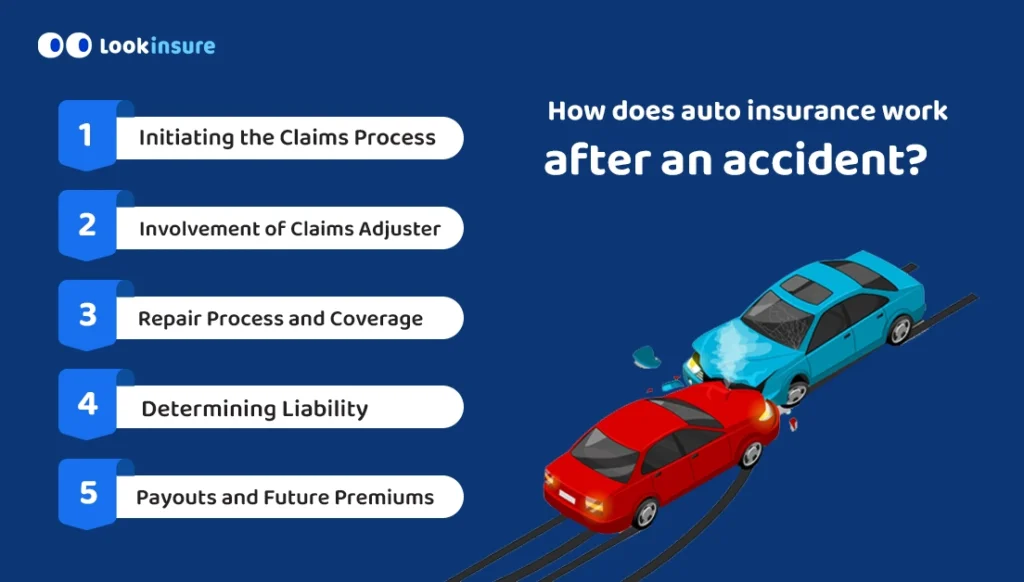
- Report the accident. Call 999 if anyone is hurt. Minor collisions in Dubai can be reported through the Dubai Police app instead of waiting at the scene.
- Get the police report. The at-fault driver receives a red report and the driver not at fault receives a green report. No insurer will process an accident claim without one.
- Notify your insurer. Send the police report, Emirates ID, driving licence, vehicle registration (Mulkiya), your policy number and photos of the damage.
- Inspection. The insurer’s surveyor inspects the car and approves a repair estimate.
- Repair or payout. The car goes to an agency or an approved garage, depending on your policy. Your excess and any depreciation are deducted, or the insurer pays the insured value if the car is a total loss.
Each insurer runs its own claims channel and hotline. The claim numbers for ADNIC car insurance, for example, sit on its provider page, and our guide on how to claim car insurance walks through the forms insurer by insurer.
How does car insurance work if you hit someone?
If you hit someone and receive the red report, your insurer pays the other driver’s repairs up to AED 2,000,000 and any injury compensation without limit. Your own car is repaired only if you hold comprehensive cover, and you pay your excess. You will usually lose your no-claims discount at renewal. With a green report, you claim from the other driver’s insurer and normally pay no excess.
How long does a car insurance claim take in the UAE?
A straightforward repair claim with a clear police report typically takes three to ten working days from submission to repair approval, and claims with disputed fault or heavy damage run two to four weeks or longer. Only one deadline is fixed in law: for a total loss, Article 7 of Insurance Authority Board Decision No. 25 of 2016 requires the insurer to pay within 15 days of the claim documents being complete. There is no equivalent legal deadline for ordinary repair claims. Our guide to how long a claim takes breaks the timeline down by claim type.
What a claim does to your next premium
An at-fault claim usually resets your no-claims discount, so the next renewal costs more even if the repair itself was paid in full. Drivers with several claim-free years can keep a substantial no-claims bonus, which is why some drivers pay for a small repair themselves rather than claim.
Add-ons that change how your policy works
Add-ons extend a comprehensive policy beyond its standard terms. Roadside assistance cover pays for towing, battery boosts and lockouts. Personal accident cover pays a fixed sum to the driver or passengers for death or permanent disability, which TPL alone does not provide for your own occupants. Agency repair, zero depreciation and Oman extension cover are the other add-ons UAE drivers ask about most.
What buying a policy looks like in practice
- Choose the cover. Decide between TPL and comprehensive, and between agency and garage repair.
- Gather documents. Emirates ID, UAE driving licence, vehicle registration (Mulkiya) and, if you have one, a no-claims certificate from your last insurer.
- Compare quotes. Enter the same details once and compare premiums, excess and add-ons across insurers.
- Pay. Pay by card in full or in 4 instalments.
- Receive the policy. The policy is issued digitally and appears on your RTA vehicle record, ready for registration renewal.
Check the full list of documents required for car insurance before you start, then compare car insurance quotes in the UAE from 30+ insurers in one place. If you want a shortlist first, our ranking of the best car insurance companies in Dubai explains how each insurer handles claims and repairs.
Frequently asked questions
What is car insurance?
Car insurance is a contract in which a vehicle owner pays a premium to a licensed insurer, which then pays for specified losses involving the car. In the UAE, every policy must cover injury and damage caused to other people. A comprehensive policy also pays for damage to, or theft of, your own car.
How does car insurance work in Dubai?
You pay a yearly premium, and the insurer pays for covered losses minus your excess. Every car needs at least third-party liability cover to be registered. After an accident, the police report decides who is at fault, and the at-fault driver’s insurer pays the other driver’s repairs and any injury compensation.
What does car insurance cover in the UAE?
Third-party liability covers injury to other people without limit and damage to their property up to AED 2,000,000 per accident. Comprehensive cover adds accident damage to your own car, theft and fire, and usually flood and storm damage. Add-ons such as roadside assistance and personal accident cover extend it further.
How is car insurance determined?
Insurers price car insurance on how likely you are to claim and how costly a claim would be. The main factors are your age, licence history and claims record, the car’s make, model, age and value, the cover and repair type, the excess you choose and the emirate where the car is registered.
How much does car insurance cost in the UAE?
Third-party car insurance starts from AED 600 a year and comprehensive from AED 1,350 a year on Lookinsure, verified October 2026. A comprehensive premium usually works out at 1.5% to 3% of the car’s market value. Young drivers, new licence holders, luxury cars and agency repair cost more.
What are the car insurance limits in the UAE?
The Unified Motor Vehicle Insurance Policy sets the minimum limits. Injury or death of other people is covered without any upper limit, at the amount a court awards. Damage to other people’s property is covered up to AED 2,000,000 per accident. Insurers cannot sell third-party cover below these limits.
How does car insurance work if you hit someone?
If you are at fault, your insurer pays the other driver’s repairs up to AED 2,000,000 and their injury compensation in full. Your own car is covered only under a comprehensive policy, after you pay your excess. An at-fault claim usually removes your no-claims discount at the next renewal.
How long does a car insurance claim take in the UAE?
A straightforward repair claim with a clear police report usually takes three to ten working days to approve. Claims with disputed fault or heavy damage take two to four weeks or more. For a total loss, UAE regulation requires the insurer to pay within 15 days of receiving complete claim documents.
Can new drivers get car insurance in the UAE?
Yes. New drivers can buy both third-party and comprehensive cover, but drivers under 25 and anyone with a UAE licence held for under a year pay higher premiums. Insurers may also add an extra excess of up to 10% of a claim when the driver is under 25. A claim-free first year lowers the price.



Comments (0)
Leave a comment